


James Dyson Award 2026: Calling The Next Generation Of Problem-Solvers
The James Dyson Award, a global design engineering competition that has supported more than 400 inventions, opens for submissions today for 2026. The Award invites current and recent design and engineering students across 28 countries and regions to present ideas that tackle real-world problems.
Shortlisted entries will be reviewed by national judging panels of design and engineering experts, including Dyson engineers. National winners will receive £5,000 and a chance to progress to the international stage. Sir James Dyson will select global winners to receive £30,000 and a platform to take their inventions to the next level.
The Award gives winners media exposure, international recognition,and the momentum for these young inventors to accelerate their ideas to commercialisation.
Sir James Dyson, Founder of Dyson, said: “I established the James Dyson Award to encourage young ‘doers’ in life who are focused on solving the problems they see in the world, not grandstanding about them. It has been inspiring to see so many brilliant ideas from young design engineers, many of whom have gone on to build businesses andtaketheir problem-solving ideas to people and marketsall over the world. I look forward to judging this year’s submissions.”
2025 winners
In 2025, the James Dyson Award marked its 20th year and received more than 2,100 inventions from young engineers worldwide. Projects provided solutions in areas such as health screening, household waste, and disaster relief.
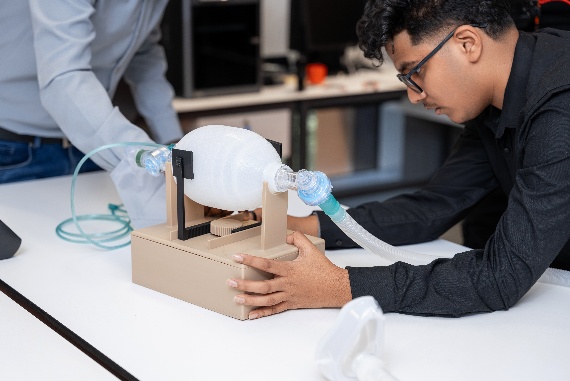
The 2025 UAE James Dyson Award was awarded to a team of five engineering students from University of Wollongong in Dubai, Heriot-Watt University and Middlesex University who developed DRBVV (Disaster Relief Backup Volume-Based Ventilator). A low-cost portable emergency ventilator designed to address critical shortages in hospitals, rural clinics and disaster relief situations. The ventilator delivers precise, repeatable compression of an Ambu bag using a motor-driven mechanism, integrated electronics and a user-friendly touchscreen interface.
The global Sustainability prize was awarded to WaterSense, an autonomous water quality monitoring device. Invented by Filip Budny from Poland, a PhD candidate in nanotechnology at Warsaw University of Technology, WaterSense replaces manual, occasional sampling with real-time, AI-powered monitoring and early pollution alerts.
OnCue, the global Medical winner, is a smart keyboard for people with Parkinson’s. Invented by Italian product designer Alessandra Galli, who graduated from Delft University of Technology in the Netherlands, OnCue uses haptic and visual cues to manage motor symptoms and reduce typing errors.
How to enter
Entries can now be submitted via the James Dyson Award website, with the deadline set for midnight on 15th July 2026. University students and recent graduates of design and engineering subjects are eligible to apply.
The best entries tackle a clear global problem, demonstrate a thoughtful design process, and showcase originality and technical feasibility.

UAE Survey Reveals Major Leap In Financial Inclusion – 94% Now Have A Personal Bank Account

Why Fertilizer, Food Security and Clean Ammonia Are Becoming Part of the Same Story

ne’ma’s Ramadan Campaign Drives Major Impact In Food Rescue And Redistribution
About The Author