


How SPL Made Round-The-Clock Access Possible Beyond The Card Catalogue Era
At Sharjah Public Libraries (SPL), borrowing a book is no longer limited by opening hours, or even by the library doors. Through the Smart Locker service, members can collect reserved books at any time round-the-clock. Readers place requests via the online catalogue, then pick up their items from the smart lockers located at SPL’s rear entrance, using either their valid Emirates ID or a membership card. It is a practical step towards a more flexible, user-centred model of library service.
What makes this kind of convenience possible, however, is the less visible work that libraries have always done: organising knowledge so it can be found. SPL’s cataloguing is built on established international standards, including Anglo-American cataloguing rules and the Dewey Decimal Classification system.
For an institution with roots going back to 1925, cataloguing has remained the backbone that connects readers to collections, through the transition from a single library into a network of six branches serving cities across the emirate. Today, the system supports a collection of more than 791,328 resources and access to over 15 million digital items.
From cards to automated cataloguing
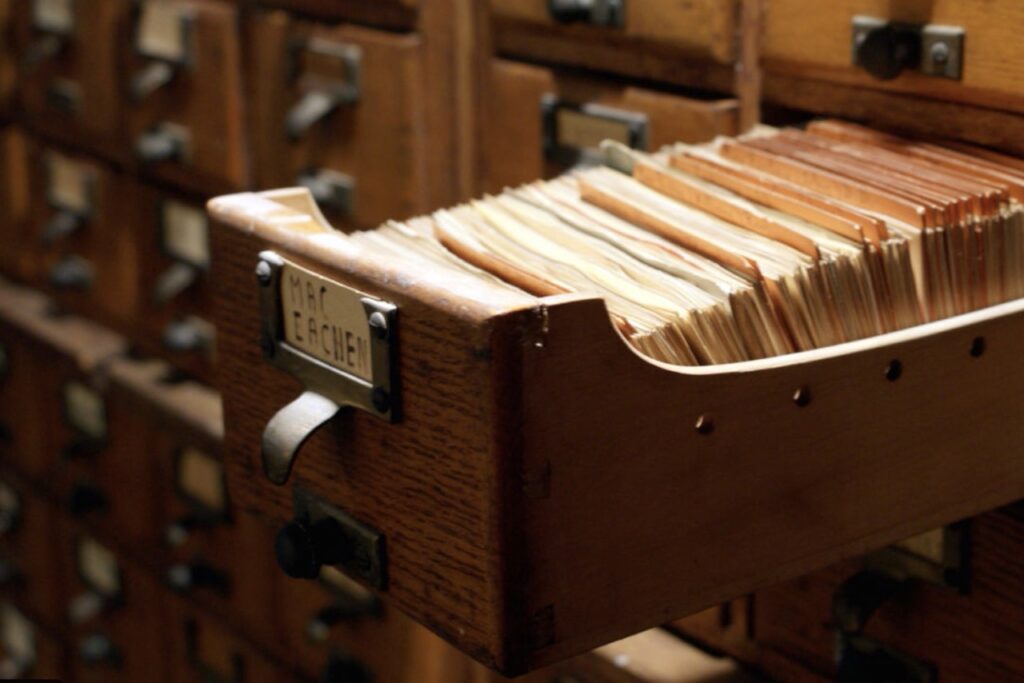
To appreciate how far the cataloguing system at SPL has evolved, it helps to look at the global story of the card catalogue. One of the earliest documented uses of cards dates back to 1791, during the French Revolution, when libraries arranged cards alphabetically by author or title. By 1840, Harvard Library had adopted a structured card catalogue system that became influential far beyond its campus.
The approach later scaled dramatically through the Library of Congress, which began printing catalogue cards for new books in 1901. Over time, the card catalogue became a vast infrastructure, eventually reaching more than 22 million cards stored across 22,000 drawers. Yet by the end of the 20th century, the system was in decline: the Library of Congress records that the last catalogue card was printed in 1997.
The real breakthrough came with the transition to ‘Machine Language’ when libraries began to standardise bibliographic data for computers. The introduction of the MARC (Machine Readable Cataloguing) standard in 1968 allowed records to be created in a machine-readable form and shared between systems.
That, in turn, made co-operative cataloguing possible, enabling libraries to reuse records rather than creating them from scratch. The shift gathered pace with the launch of the first large-scale shared electronic cataloguing network in 1971, and the printed card catalogue gradually disappeared altogether, with printing finally ending in 2015.
Digital transformation in Sharjah
At SPL, a major turning point came with the opening of the new main building in 2011, which accelerated service modernisation and supported a systematic move to automated catalogue management and lending systems in both Arabic and English. By 2019, thousands of e-books and audiobooks were available through the SPL’s digital platform.
In 2020, the practical value of that investment became clear. Access expanded to millions of multilingual electronic resources, contributing to a 70% increase in membership and attracting users from dozens of nationalities.
Digital transformation also shaped the libraries’ learning, educational and professional offering. In 2021, SPL launched the Smart Knowledge Library, a platform for specialised virtual courses. In 2025, it was upgraded with short learning pathways, online assessments and instant certificates, designed for seamless use on smartphones.
Alongside services, SPL have also been looking ahead to the future of library work. SPL announced the theme ‘Artificial Intelligence in Libraries: Innovation and Impact’ for the 26th edition of the Sharjah Libraries’ Literature Award, signalling a shift towards enhancing institutional practice through advanced technologies..
Globally, libraries are now exploring what comes after the MARC system and the conventional search interfaces. Attention is increasingly turning to linked-data models that connect bibliographic records within wider semantic networks, improving discovery and opening new routes for research.
In that context, SPL’s centenary tells a clear story of steady progression: from cataloguing designed to help readers locate a book on a shelf, to digital discovery at scale, and towards a next phase focused on smarter, more precise search that combines global standards with the local knowledge and identity reflected in its collections.

Alabbar Enterprises Launches Second ‘Helping Hands’ Initiative To Feed Those In Need

Yalla TV Enhances Production Capabilities And Launches Internship & Mentorship Program For UAE Students

French Space Tour: French Space Delegation Embarks On Strategic Tour In United Arab Emirates
About The Author