


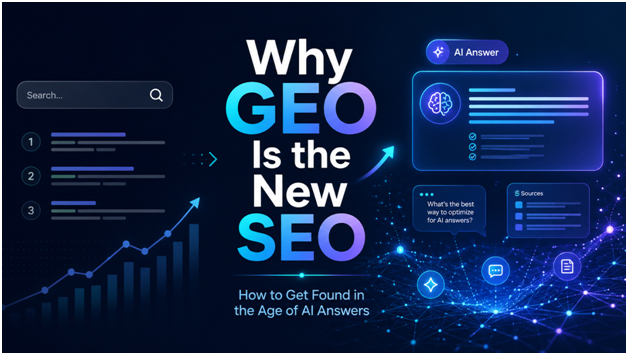
Why GEO Is the New SEO: How to Get Found in the Age of AI Answers
Picture this: Someone types a question into Google, ChatGPT, or Perplexity, and instead of seeing ten blue links, they get a single, confident paragraph of an answer. No scrolling. No clicking. No choosing between websites. Just the answer – and maybe a handful of sources cited at the bottom.
That moment is happening billions of times a day right now. And if your website, brand, or content isn’t structured to be the source those AI engines pull from, you simply don’t exist in that answer.
Welcome to the era of Generative Engine Optimization – or GEO. It is arguably the most important shift in how people find information since Google launched over two decades ago, and most businesses are still catching up.
First, Let’s Understand What Actually Changed
For nearly twenty years, SEO – Search Engine Optimization – was the gold standard for getting found online. The premise was simple: understand what terms people type into search boxes, put those terms on your page, earn links from other sites, and Google would reward you with a high ranking. Traffic followed. Business followed.
That system still works. But it is no longer the whole game.
Generative AI has introduced a fundamentally different kind of search experience. Tools like ChatGPT, Google’s AI Overviews, Microsoft Copilot, Perplexity, and Claude don’t just index web pages and point users toward them. They read, synthesize, and respond. They construct answers in natural language, often without requiring the user to visit a single website.
This changes everything about how visibility works. The question is no longer just, “Does my page rank on page one?” The question is now, “When an AI answers a question in my niche, am I the source it trusts?”
What GEO Actually Means (Beyond the Buzzword)
Generative Engine Optimization is the practice of structuring, writing, and presenting your content so that AI-powered systems are more likely to understand it, trust it, and use it when generating responses to user queries.
Think of it as speaking the language of AI. Here is what that really means in practice:
- Writing content that directly and clearly answers real questions – not writing for keyword density.
- Building authority signals that AI models recognize, such as citations, data references, expert attribution, and factual consistency.
- Structuring information in a way that is easy for a language model to extract and repackage cleanly.
- Earning mentions and references across the web – what some now call “citations in AI,” analogous to backlinks in traditional SEO.
The term itself was popularized through research out of Princeton, Georgia Tech, and IIT Delhi, where a 2023 study showed that specific content strategies could measurably increase the frequency with which AI systems cited a given source. That research gave the field its name and its first empirical grounding.
The Traffic Problem Nobody Is Talking About Loudly Enough
Here is the uncomfortable reality that website owners are starting to notice in their analytics: AI-generated answers reduce click-through rates. When someone gets a complete answer directly on the search results page or inside an AI chatbot, they don’t need to click anywhere.
Google’s own data has shown a correlation between the rollout of AI Overviews and changes in organic click behavior. Perplexity, which serves millions of queries daily, often provides full research summaries with only one or two outbound source links. ChatGPT with browsing enabled cites sources, but most users never leave the interface.
This is sometimes called the “zero-click problem,” but that framing misses something important. Zero clicks on your site is not the same as zero value from the interaction. If an AI cites your brand as an authority, if it quotes your statistic or references your research, you gain something that was previously impossible to measure: ambient credibility.
A user who hears your brand name cited in an AI answer three times over a month is building a mental association with your expertise. When they eventually do have a decision to make, that recognition matters enormously. GEO is not just about driving traffic. It is about embedding your brand into the informational ecosystem of your niche.
How AI Engines Actually Decide What to Include
To optimize for AI systems, you need to understand how they think about sources. It is a different calculus than Google’s PageRank.
Relevance and Specificity
AI models favor sources that are specifically about the topic being asked, not broadly tangential to it. A page that directly and completely answers a question beats a comprehensive guide that only partially touches on it. This is why laser-focused, question-answering content performs well in AI citation – even if it has relatively modest traditional SEO metrics.
Credibility Signals
These include author credentials, institutional affiliations, dates, citations to external data, and the factual accuracy of the surrounding content. A blog post written under a pseudonym with no external data references will almost always lose to a piece with a named author, a published date, referenced statistics, and links to original sources.
Content Structure and Extractability
AI systems need to extract the relevant portion of your content efficiently. Pages with clear headers, logically sequenced information, and well-defined answers to distinct questions are far easier for a language model to parse and repackage. Dense paragraphs of meandering prose, no matter how well-written, are harder to extract value from.
Cross-Web Presence and Mention Volume
When multiple independent sources reference the same entity, claim, or brand, AI systems gain more confidence in its legitimacy. This is why being quoted in industry publications, mentioned in forums, cited in research, and referenced by journalists all matter for GEO. It is not just about your own website anymore – it is about your presence across the information landscape.
GEO vs. SEO: Friends, Not Competitors
One thing worth saying clearly: GEO does not replace SEO. The two practices complement each other deeply, because the foundation of both is the same. Quality content that genuinely helps people. Clear, logical structure. Authoritative information. Earned trust over time.
Where they diverge is in emphasis and tactics. Traditional SEO leans heavily on keyword strategy, link building, technical site architecture, and page ranking metrics. GEO shifts focus toward answer completeness, entity recognition, structured data markup, credibility signals, and off-page citation building.
The smartest approach in 2025 and beyond is to do both together, using a GEO lens to refine and strengthen your existing SEO content strategy. Most businesses that get this right will have a significant visibility advantage over competitors still optimizing purely for a ten-blue-links world that is increasingly rare.
Real-World Examples: Who’s Already Winning at GEO
Some organizations are already ahead of this curve, often without having labeled what they’re doing as “GEO.”
Medical and health information publishers who built their reputations on accurate, physician-reviewed content are being cited constantly in AI health answers. They built credibility over years, and AI systems recognize it. Research institutions and universities whose papers and studies are publicly accessible get cited when AI systems answer questions in those fields – because the content is authoritative, structured, and publicly indexed. Niche industry publications that write deeply specific, well-referenced articles on narrow professional topics are consistently surfacing in AI answers, even though they may not have enormous domain authority by traditional SEO measures.
The pattern is clear. Depth, accuracy, structure, and authority win in the AI citation game.
Where to Begin: A Practical First Move
If you’re reading this and wondering where to start, here is the most practical first step: audit your ten most important pages through a GEO lens.
Ask yourself these questions for each one:
- Does this page directly and completely answer a specific question that someone might ask an AI assistant?
- Is there a named author with verifiable credentials?
- Are the claims backed by data, studies, or references to authoritative sources?
- Is the page dated, and is the date visible and accurate?
- Could an AI easily extract a single, clean answer from this page without ambiguity?
Any page that fails multiple of these criteria is a priority for revision. Not because your rankings will drop tomorrow, but because the informational world is quickly moving to a place where AI acts as the first layer of discovery – and pages that AI cannot understand and trust will simply be invisible.
The Bottom Line
Generative Engine Optimization is not a trend to watch from the sidelines. It is a genuine paradigm shift in how human beings find and consume information. The organizations that understand this early and adapt their content strategies accordingly will enjoy outsized visibility in a world where AI does the first layer of research for almost everyone.
The good news? The core principle is timeless: be genuinely useful, be clearly authoritative, and make it easy for others – human or machine – to understand and trust what you know.
That has always been the point. GEO just raises the stakes for getting it right.
Contributed by GuestPosts.biz

Booster Shots Effective In Reducing Viral Load, Decrease Transmission, Says Doctor

Smart Salem To Expand UAE Residence Visa Processing Services In DIFC

Voices Of Future Generations Celebrate UAE-Based Child Authors Global Book Launch
About The Author